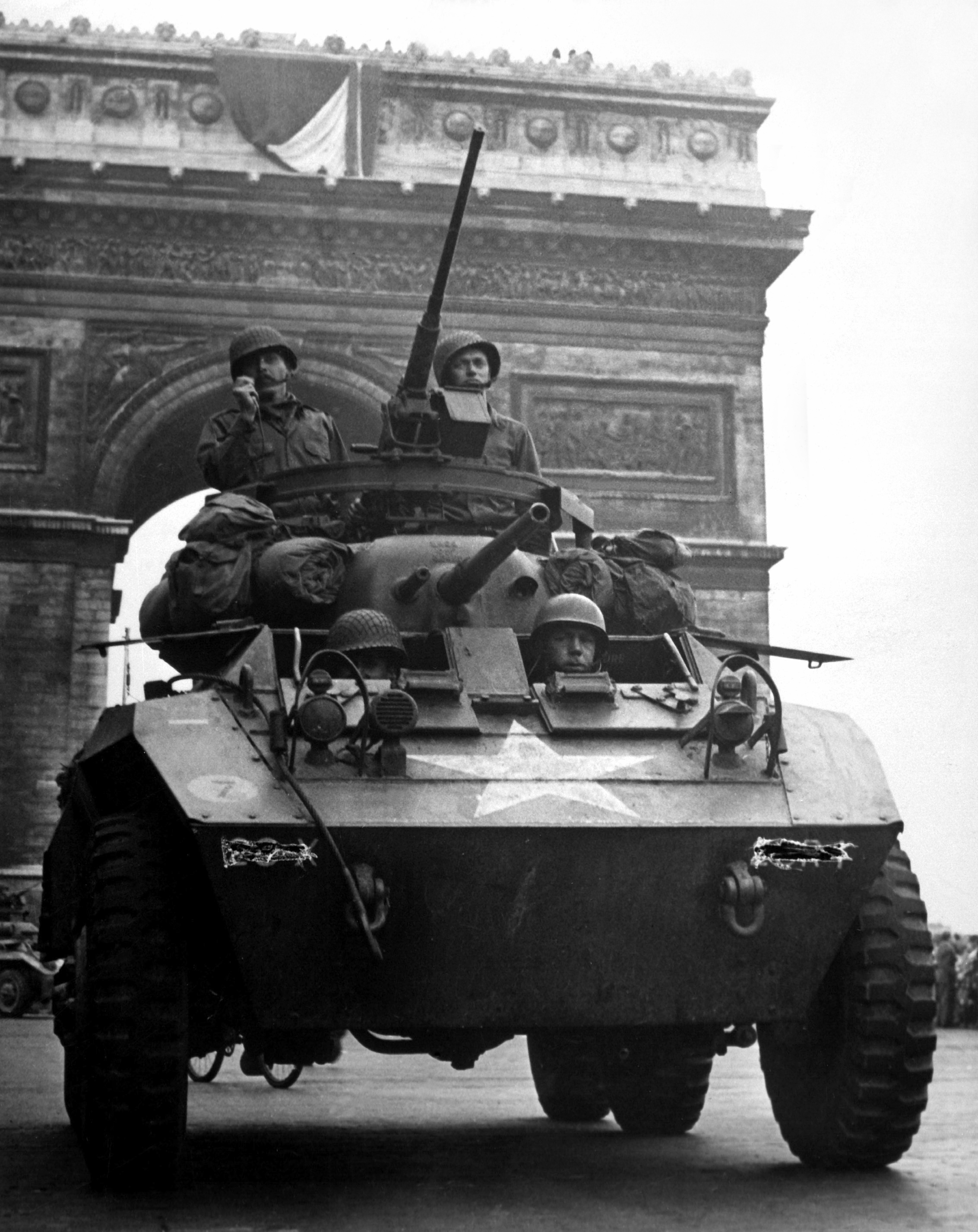
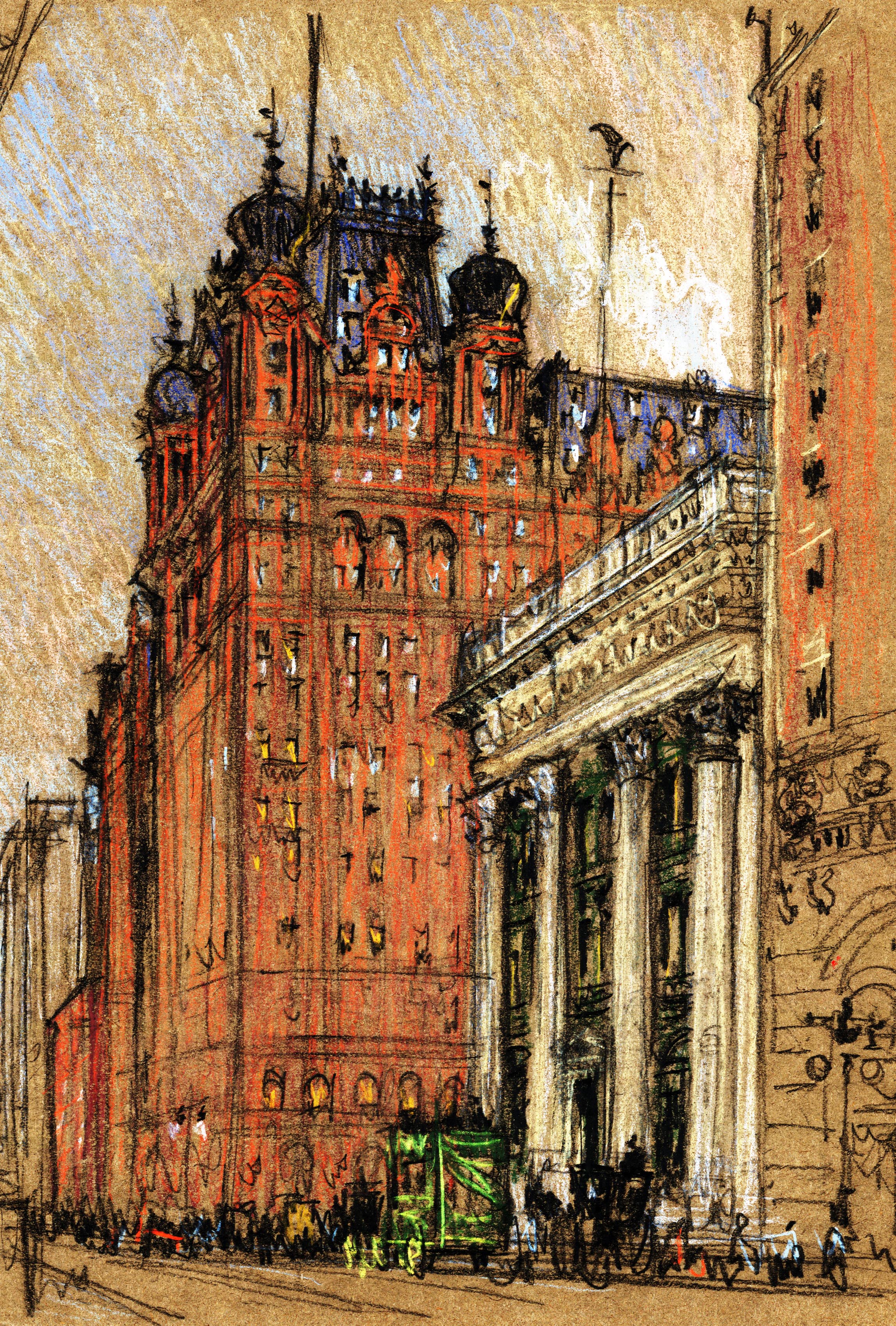
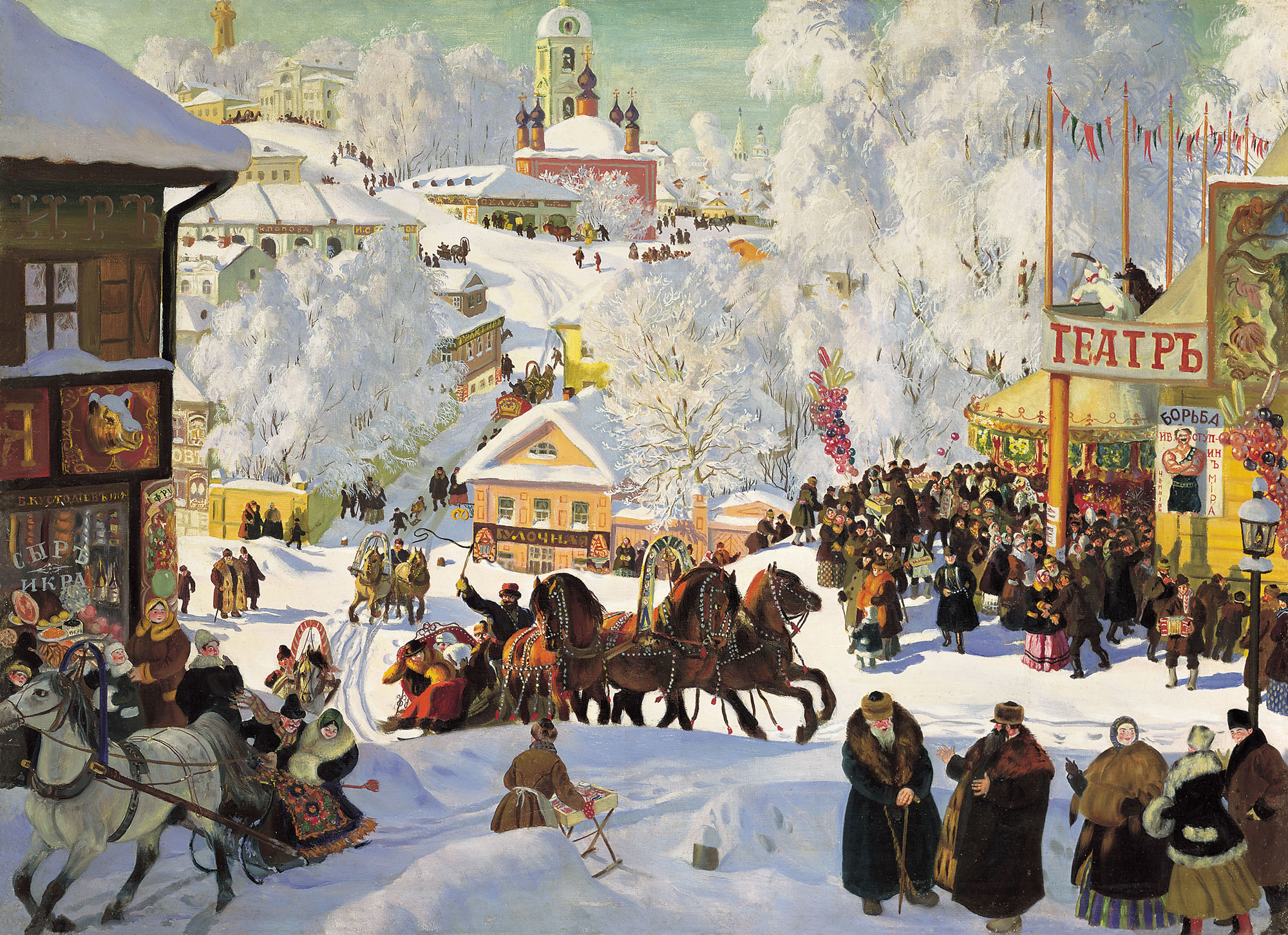
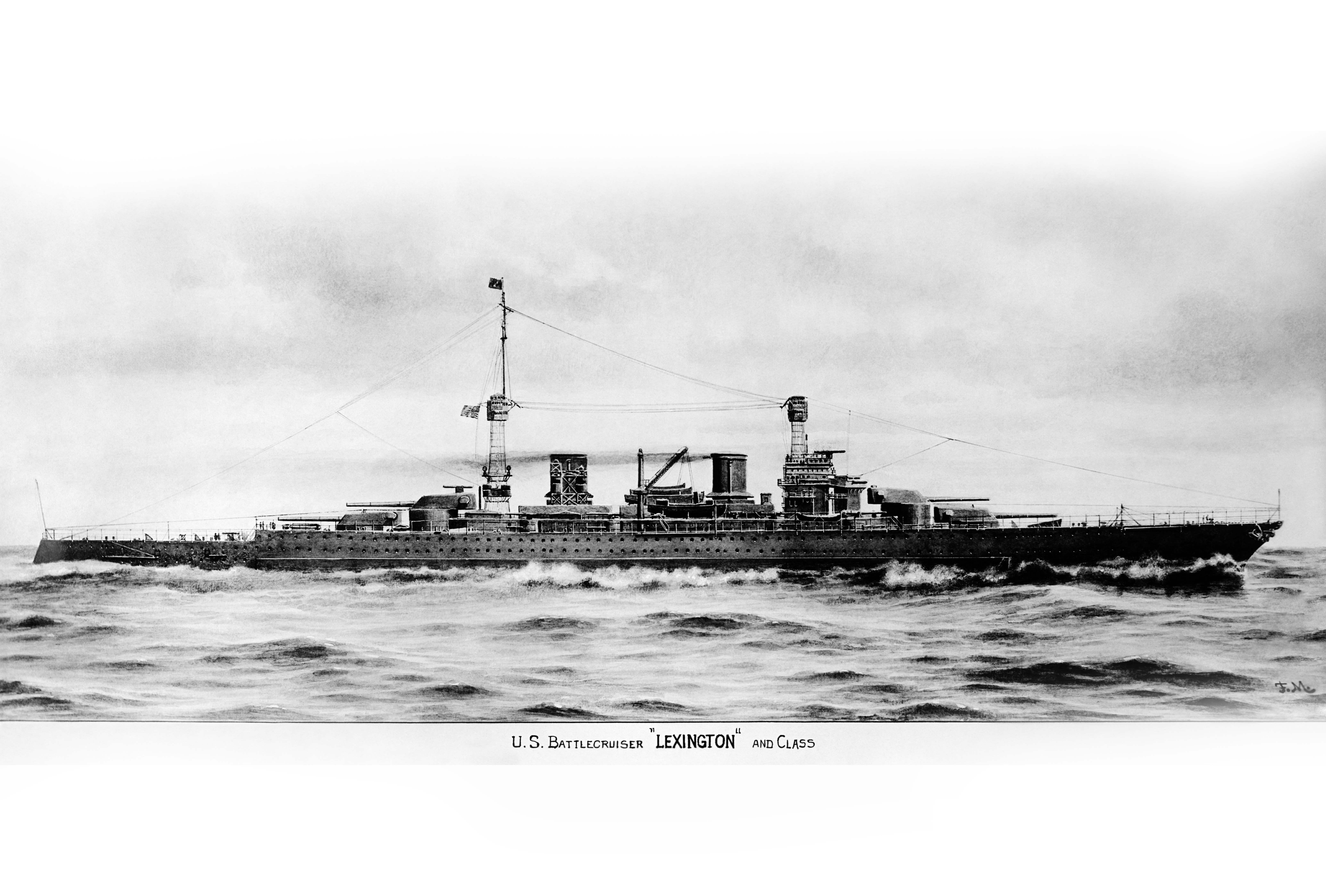
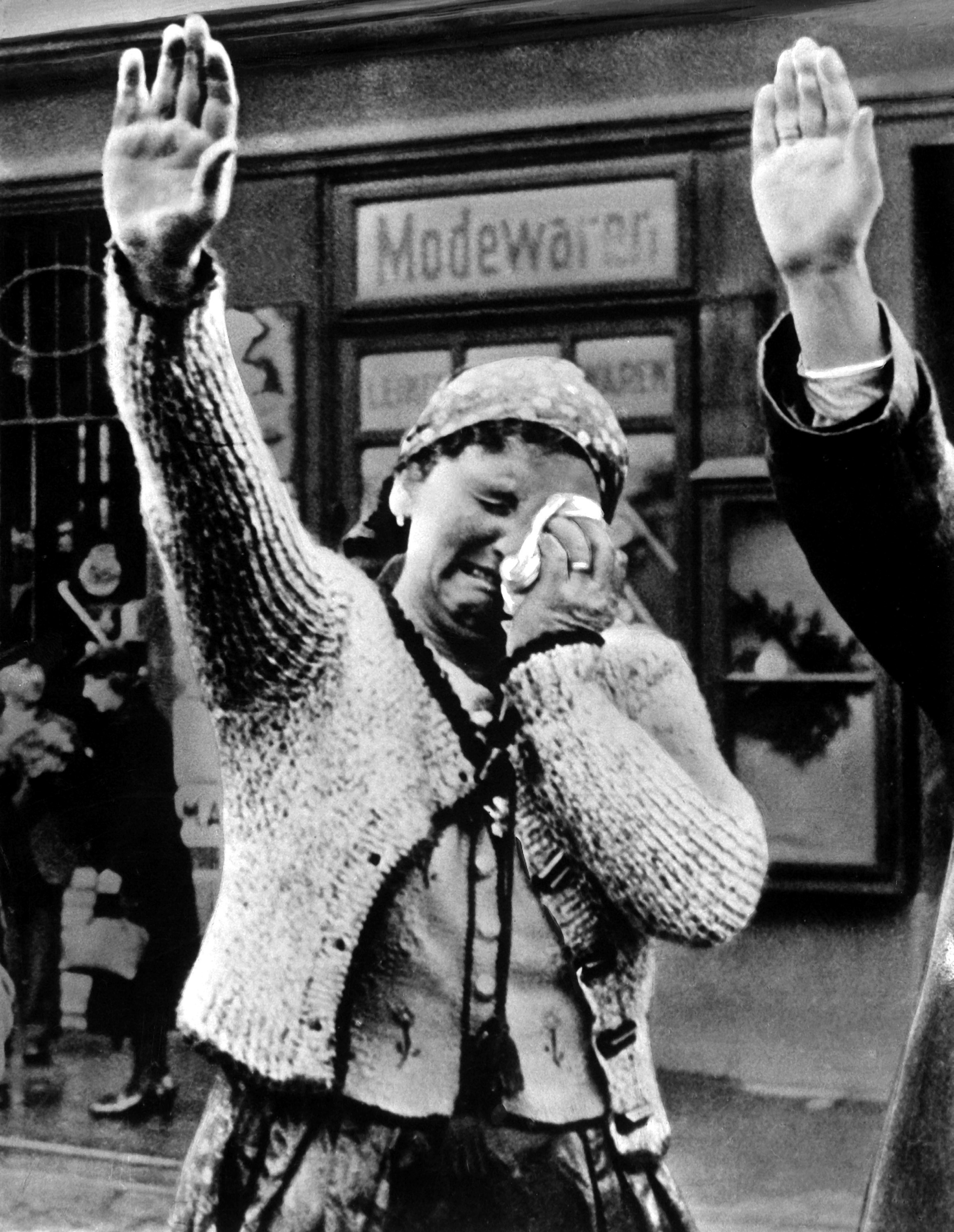
American troops in an M8 Greyhound passing the Arc de Triomphe during a parade celebrating the liberation of Paris, which concluded 65 years ago today. Paris had been administered by Nazi Germany since the Second Compiègne armistice in June 1940 when Germany occupied the North and West of France and when the Vichy puppet regime was established with its capital in the central city of Vichy. This battle marked the end of Operation Overlord, the restoration of the French Republic and the exile of the Vichy government to Sigmaringen in Germany.A sketch of the original Waldorf-Astoria Hotel, a luxury hotel in New York City, done in charcoal and pastel on brown paper by Joseph Pennell, ca. 1904–1908. It started as two hotels: one owned by William Waldorf Astor, whose 13-story Waldorf Hotel was opened in 1893, located on the current site of the Empire State Building, and the other owned by his cousin, John Jacob Astor IV, called the Astoria Hotel and opened four years later in 1897, four stories higher. Initially foreseen as two separate entities, founding proprietor George Boldt planned the new structure so it could be connected to the old, and the combined hotel became the largest in the world at the time. The Waldorf-Astoria relocated to its present location in 1931.Maslenitsa, a 1919 painting depicting the carnival of the same name, which takes place the last week before Great Lent. The painting encompasses a broad range of things associated with Russia, such as snowy winter weather, a troika, an Orthodox church with onion domes. Painted in the aftermath of the October Revolution, the canvas was intended as a farewell to the unspoilt "Holy Russia" of yore.A 1919 painting depicting the definitive design of the Lexington class battlecruiser, the only class of battlecruiser to ever be ordered by the United States Navy. Six were planned as part of the massive 1916 building program, but their construction was repeatedly postponed. Four of the ships were eventually canceled, and the remaining two (Lexington and Saratoga) were converted into the United States' first aircraft carriers.The structure of a quick response (QR) code, a type of matrix barcode that can encode virtually any kind of data. Originally developed for the automotive industry to track vehicles during the manufacturing process, it has since become one of the most popular types of two-dimensional barcodes. The QR code is detected as a 2-dimensional digital image by an image sensor and is then digitally analyzed. The processor locates the three distinctive squares at the corners of the image, and uses a smaller square near the fourth corner to normalize the image for size, orientation, and angle of viewing. The small dots are then converted to binary numbers and validity checked with an error-correcting code.A crying Sudeten woman salutes Adolf Hitler as German forces sweep into Czechoslovakia, October 1938. Originally published in the V?lkischer Beobachter, it supposedly showed the intense emotions of joy which swept the populace as Hitler drove through the streets of Cheb, 99% of whose inhabitants were ardently pro-Nazi Sudeten Germans at the time. In contrast, when the photo was published in the U.S., it was captioned, "The tragedy of this Sudeten woman, unable to conceal her misery as she dutifully salutes the triumphant Hitler, is the tragedy of the silent millions who have been 'won over' to Hitlerism by the 'everlasting use' of ruthless force." It is unknown what the true circumstances surrounding the photo are.